
Customer Profile No. 03
The community knows who takes care of them
Fractional CMO Katie Smith learned marketing from an owner who walked the office every morning asking about people's families. Sixteen years and three platform shifts later, she still measures marketing by the same thing: whether the people around you are taken care of, and whether the community can tell.
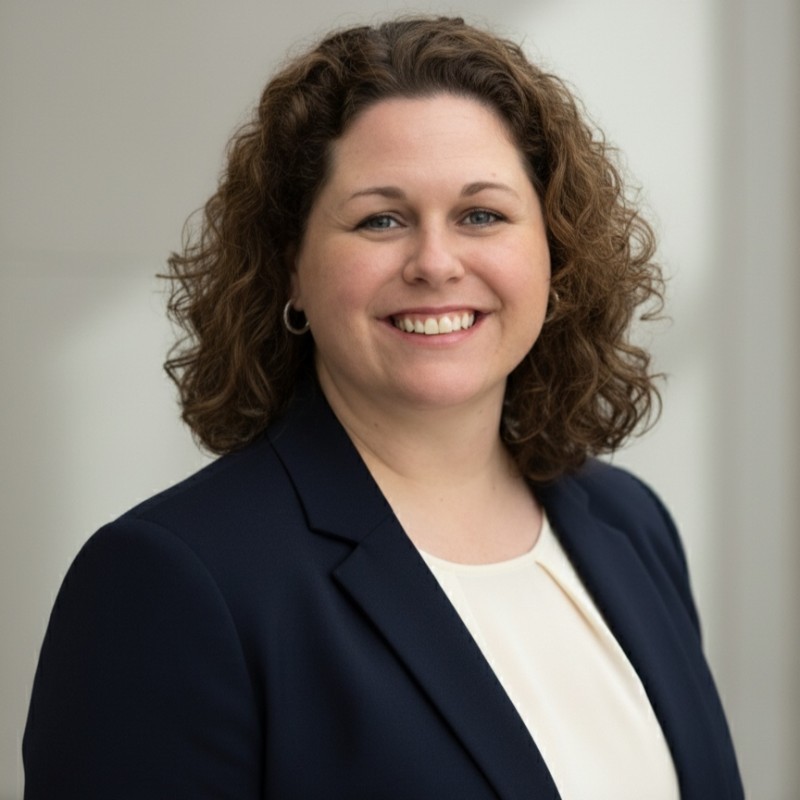
Katie Smith has a short answer for what marketing is for. It isn't the P&L, though she watches that. It's the dispatcher looking at a board with no calls on it, and the technician who gets sent home early because there is nothing to run. "That's to me what the marketing has always been about," she says. "The technicians and the CSRs and the employees who need these companies to be successful so they can provide for their families."
It is not the usual way a marketer talks about attribution and budgets. But it explains almost everything else about how she works, and she learned it in her first three weeks in the trades.
"How's your family?"
She didn't plan on the trades. Political science degree, then two and a half years selling Saturns, event marketing, then a year and a half at a national nonprofit where she had to fire telemarketers who missed their numbers in three days. She hated that. A staffing recruiter kept mentioning a plumbing company in Greenville that wanted to do inside sales. One frustrated day she said, give me the interview.
Chris Corley hired her. Corley Plumbing Air Electric had 33 people, five of them in the office, and an owner who walked through every morning. He never asked what you were working on. "It was, hey, how are you? How's your day? What's going on? How's your family?"
"I was at Corley for three weeks when I knew I was somewhere different."
She stayed nearly a decade. She was hired for inside sales, but every time Chris brought her a new problem, she said yes and figured it out. That's how she built a marketing program from the phone book up. The Yellow Pages renewal came up and Chris asked if she wanted to help with it, so she worked on the ad copy with the phone book designers. When the company needed a website, rare for a contractor in 2010, he asked her to work with the digital agency on that too. Google Ads followed, because Google Ads were becoming a thing. Then, around 2013, Chris told her they didn't have enough applicants and asked her to look into it. She came back the next day and told him the applicants were fine, they just weren't interviewing them, and ran recruiting for the next two and a half years alongside marketing. "He always gave me a chance and a choice on what I wanted to do."
Why Chris let the competition in
Chris sat on the Nexstar board. Nexstar caps how many members it allows in a market, and Chris kept letting local competitors in anyway. Katie asked him once whether that worried him, since there are only so many strategies.
He told her no. The more companies in Greenville doing it the way Corley did it, the easier it would get to walk into a customer's home, because homeowners would come to expect a professional: shoe covers, a clean truck, a phone that gets answered, a job finished the first time. Raise the standard for everyone and the whole community is better served.
That answer shaped her view of the industry. Everyone has access to roughly the same playbook. The difference is what happens when the technician gets to the door. "People can have the same playbook. Doesn't mean they're going to execute it the same way." She saw it again years later across a group of brands running her identical marketing plan; some had far more success than others, and the gap was always operations.
What a brand is, and what it survives
Corley went from the phone book to Google Ads and kept growing through every shift. Katie's explanation is not a tactic. "It didn't matter what the tactic was. We had built our brand. The community knew us. They knew who to call and they knew who would take care of them."
She proved it again at Preferred Home Services in Charleston. When an acquisition in Greenville fell apart right before signing, leadership asked what she would do. "I said, well, give me the money. Let me market Greenville." She had 37 days to launch a greenfield location. It did $5 million in its first year, with a great operations team and a plan that went hard on brand and direct response together.
Her worry is that the industry has drifted from that. "Did we get lazy as an industry? Well, I can just buy a lead. I don't have to go out in the community." She has watched the price of that shortcut change. She has watched Local Services Ads fill up as getting in got easier for everyone. "We used to get an LSA lead for like $8. Now you're like, okay, $80 might be a good thing."
"People want to know who they're doing business with. They want to know who they're working with. And that's what matters."
The thread
Moving target, moving platform, moving ground
Three profiles in, a pattern is forming. Justin Schmidt said marketing in the trades is hitting a moving target from a moving platform. Katie read that line and said it was so true, then added the third thing that moves: the ground under the platform. The phone book gave way to Google. LSA went from $8 a lead to $80. AI is next, and she assumes it will shift too. "Change is the one thing that has always been consistent."
Brian Sooy gave the sequence for planning through it: learn from hindsight, guide with insight, lead with foresight. Katie's version is below. Hindsight is a year of closed-revenue data per client. Insight is seeing where the seasonality actually is. Foresight is a 2027 budget built on that, plus the one thing none of the platforms can take away, a brand the community already trusts.
The conductor
Since September 2025, Katie has worked for herself. She went out on her own for two reasons: to be there while her daughter grows up, and to help family-owned and operated companies win. She keeps her roster small on purpose, all in the Southeast. "It's just me. You're not going through layers. You get me unfiltered, which I love."
The work runs from six-month strategy to the email that needs to go out this week. She listens to calls, coaches call centers, notices when average ticket drops $150 in one department, and figures out whether that's a marketing problem or an operations problem. She isn't a PPC or SEO specialist, by design. Her clients have digital partners, direct mail vendors, email partners. She is the conductor who makes sure they all know what the others are doing, because what happens in the community shows up in the digital numbers whether the digital agency knows it or not.
Every one of those vendors arrives with its own reporting. She recently heard the familiar pitch from yet another vendor.
"Everyone always has their own dashboard. They're like, well, we have our own proprietary dashboard. I'm like, that's great, but we're going to use ours."
Ours means SearchLight, because it makes the metric the same across every partner. She'll accept the impressions report, then ask where the closed ROAS is. That one shared number changes the conversation when a channel underperforms. The same technicians run the calls and the same CSRs book them across every channel, so if closed ROAS is good on three channels and bad on a fourth, the fourth is a tactic problem, not a people problem. "I don't care what digital partner you go to, never give up your SearchLight. That's your keys to understanding."
Budget season, done differently this year
Katie is in the middle of 2027 planning for clients who now have a year of SearchLight data, and she says this is the first budget she has built with it. The old way was a number and a list of everything you could do with it. "The strategy in the past has always been, well, we know February is slow in revenue, so pull back in marketing. Is that the best strategy?" Now she can see what CPL actually did in January and July, and plan into the seasonality instead of around it.
She is also putting numbers on something she has believed on gut feel for 16 years. "I have always known that when a company has a solid brand reputation, we spend less on a CPL. I've seen it. Now I'm getting it proven with SearchLight." The tell is branded search. A company spending $500 a month on brand campaigns and one spending $5,500 are not the same company in their community, and the cost of everything else shows it.
The second-trade data from a recent Data-Driven Trades article is already changing her campaigns. If an electrical customer is more likely to buy another trade, segment them, make sure they know about plumbing, and rebuild the outbound and direct mail around it. Most companies, she points out, never tell their customers everything they do.
The conversations you never see
A lot of the buying decision happens where no tracking number reaches. The day before we spoke, someone in Katie's neighborhood Facebook group posted about a cabinet installer. No fewer than ten people asked for his information. He will never know, and he will never see how happy she was. Her husband's workplace picks contractors the same way: someone used them, so we're calling them. No Googling involved.
"Marketing is not a straight line," she says. "Rule of thumb says seven to 10 touches, but it could be 20. There are a lot of conversations we're not involved in that we never have a picture of." It is why she wants every CSR asking what prompted the call, every time, and why she pushes vendors for matchback reports against the CRM.
Reviews have the same blind spot. Plenty of homeowners who have a bad experience never leave the one-star review, because the company knows where they live and the technician could be back. What they do instead is tell the neighborhood: if anybody asks, don't call them. "And the company is never going to see that," she says. "So does a 4.9 on Google truly match what people are actually saying about you?"
Use AI for the admin, not the customer
All of her clients are experimenting with AI, and so is she. Where she draws the line is the customer experience. "I'm always surprised when a company gets rid of all its CSRs for an AI call center. When I call, I want a person." Let AI take the admin work, she says, so people can focus on taking care of the person on the phone. Her test for any new tool is whether it could jeopardize her in six to 12 months, because she has watched enough lead sources dry up overnight to assume AI will shift under everyone's feet too.
So she is building for the places it can't reach.
"AI can't stop my mailbox. AI is probably not going to be at my community event, or on the back of the t-shirt at the field day."
It isn't about slapping a logo everywhere. "It's how do you create truly meaningful and authentic relationships with your community so that when they have a problem, they know who to trust and who to turn to."
Who the customer is
Katie has never treated marketing as its own lane. "Every point of a home service business is a spoke on the wheel. If one spoke is broken, that whole wheel isn't going to go." When dispatchers complain that technicians skip paperwork, she points out where the tech is: in a truck, or in a hot attic, focused on the homeowner. Her job is to make that person's job easier.
"Who's my customer? My customer is the CSR, the dispatcher, the technician in the field, and ultimately the homeowner." There is a responsibility in that last one too. When a homeowner picks up the phone, they should be getting truthful information from a reputable company, and she thinks about her own parents and grandparents making that call.
If she could wave a wand, she would ask for a data scientist to get through everything SearchLight now shows her, so she never misses the thing that would have kept a call on the board. Noted.
It comes back, as everything does with Katie, to the people. Chris Corley walked the office asking about families. Sixteen years later, that is still who she is marketing for.
More SearchLight Creators
No. 01 · Justin Schmidt, Hoffmann Brothers on hitting a moving target from a moving platform
No. 02 · Brian Sooy, Gorjanc Home Services on hindsight, insight, and foresight
SearchLight Creators profiles the marketers and operators driving growth inside home services companies. Know someone we should talk to? Tell us about it.