
Customer Profile No. 02
The homeowner's path to purchase is never a straight line
Gorjanc Home Services' Brian Sooy on why customers move like bees going from flower to flower, what it took to go from 30-year agency owner to in-house marketing director, and what most contractors get wrong about brand.
Watch the 2-minute version

For 23 years, Aespire was Gorjanc Home Services' agency. Any agency owner knows the tension that comes with a client relationship that long and that good: you want to give them everything, and you also have an agency to run. Over lunch in 2025, owner Phil Gorjanc put that tension on the table: "What would it take for you to be 100% devoted to Gorjanc?"
Fourteen and a half months later, Brian runs marketing inside a 63-year-old heating, cooling, plumbing, and electrical company in Northeast Ohio. He calls the first year frantic, mostly because of how much there was to do.
From the outside in
"It turned out to be an opportunity," Brian says of Phil's question. He said yes, and brought three decades of outside perspective inside.
He isn't a typical in-house hire. Brian graduated with a design degree in 1984, spent 11 years at small agencies, and founded Aespire in 1995. He's also been a type designer since 1985. One of his font families is set in the New Living Translation Bible. He still spots his typefaces on signs in places like Italy, across the U.S., and at retailers like Lowe's. "Little things making big impact," he says.
When he started Aespire, it was just his wife and him. "I'm building the desks, I'm making sure our website's updated, I'm maintaining what little social presence there was." Thirty years later, Gorjanc was the one client he'd have gone in-house for.
Ownership is a mindset
The hard part wasn't joining Gorjanc. It was figuring out who he was once he got there.
"I've struggled with that, to be honest," Brian says. "Not just joining the team full-time, but having to make this mindset shift from, 'I've been an owner for 30 years. How do I carry that mindset forward?'"
"It's been a lot of thinking and for me a lot of praying, and I really came to the realization quickly, thankfully, that my ownership is a mindset."
He credits John Beckett, chairman of a family-owned Elyria, Ohio manufacturer of heating components and author of Loving Monday, with the frame that unlocked it. Beckett talks about being a steward rather than a possessor, and Brian and his wife had always thought of their agency the same way. "I don't have to actually physically be attached to the company in that way to act and lead with an ownership mindset," he says. "I own my role, I own what I'm responsible for, I own the marketing. And not in the sense of clutching it tightly; it is my responsibility, and I'm accountable for it."
That accountability shows up as pressure. The sales team is counting on leads, and Brian catches himself carrying the whole outcome. "Why am I so frantic about this? Because this is a big responsibility," he says. "Then I have to sit back and think, but it's not just me. Ops have to perform efficiently. Sales has to close at a higher rate to make it. It's a team effort."
It also shows up in how he treats people. "That's the biggest thing in an ownership mindset on the relational side: making sure you take care of the team so they can take care of the clients."
The lines of authority are still fuzzy at times. "Sometimes I don't know where my responsibility ends, or whether I'm able to say to somebody on the CSR team, can you take care of this for us?" The relationship with Phil has made the ambiguity workable. The two share a small office, are close in age, and Brian describes Phil as a slightly older big brother. Their conversations aren't lead-count reviews. "It's more like what-ifs. What's possible? What does this make possible?"
"I would not have done this for any other client I've worked with."
A mini agency inside the company
Brian didn't stop thinking like an agency owner. He brought the model inside. He jokingly calls the marketing team Signal 63, a nod to the year Gorjanc was founded, and it works like a small shop: four outside agency partners plus platform partners, SearchLight among them. Some vendors came over from Aespire; others he's added since.
He's also cut. When he joined full-time, one of the first things he did was audit what every dollar was producing. One service was costing $5,600 a month and had generated $15,000 in revenue for the year. "I just patiently waited until the contract ended and gave them the 30-day notice." Other partners are evaluated the same way.
The agency habit he refuses to drop is treating marketing as inseparable from the rest of the business. "The marketing is really not separated from operations and sales, and operations is dependent on marketing and sales." A lead that gets lost at the CSR desk or on a slow follow-up isn't a sales problem or an ops problem. It's a company problem, and he wants to be sure the team adapts and learns.
Flywheel, not funnel
Ask Brian to draw the customer journey, and you won't get a funnel. He's written about why on his Substack.
"I think about marketing for home services not as a funnel but as a flywheel," he says. The homeowner isn't moving in a straight line from awareness to purchase.
"We're starting a pachinko board where the ball's bouncing around. Or they're like bees going from flower to flower, or it's a pinball machine."
That has two consequences. The first is patience. "The companies that are going to grow have been feeding the flywheel for 2 to 3 years, and we're seeing the effects." Results you see this quarter were paid for years ago.
The second is a different definition of a lead. Brian doesn't use the word. "I look at them as opportunities. Any call, any lead that comes in is an opportunity. The opportunity is not dismissed until they buy or until they say no." And even a no isn't the end. "People say no to the purchase, but we can keep you on and remind you that we have service."
That framing changes how he thinks about the sales team he supports. "The best salespeople build value for the customer," he says. Value for the company and value for the homeowner aren't in tension. "It doesn't have to be either or. It's both."
Hindsight, insight, foresight
For a brand strategist, Brian spends a lot of time in the data. He has a three-step frame for why.
"Extraordinary strategy learns from hindsight," he says. "First you learn from hindsight, you guide with insight, but then you lead with foresight." The reporting tells you what happened. The job is to turn that into what to do next, and eventually into seeing what's coming before the numbers do.
One example: he wanted to know why homeowners actually buy from Gorjanc, in their own words rather than in a survey.
"I went back to all the conversations in SearchLight transcripts, pulled that out, and analyzed the patterns of why people call us or why they buy from us. Not just what they're saying, but those specific reasons. I ended up with an 8-page report."
The output became a brief on the customer's real reasons, and the gaps nobody in the market was addressing. "I'm looking at gaps in the marketplace where nobody else is addressing the issue."
He's also candid that the numbers don't tell the whole story on their own. In a business where the customer bounces around for months before buying, data is the start of the conversation with Phil, not the end of it.
What a brand actually is
Brian's book Blue Collar Branding grew out of a pattern he saw across 200 companies: the trades have a branding problem at both ends.
At one end, companies over-invest in the visible parts. Logos, truck wraps, a new color scheme, with no strategy underneath. At the other, they under-invest in trust. The attitude, in his words: "I can put my name on the truck and they'll look me up."
Neither works, because neither is what a brand is.
"A brand isn't what you think it is. It's the story your customers tell themselves about your product and service and why it should matter to them."
The reason that story has to be built early comes down to the 95:5 rule, an observation from Professor John Dawes of the Ehrenberg-Bass Institute that LinkedIn's B2B Institute popularized: at any given moment, roughly 95% of buyers aren't in the market. Brian applies it to homeowners. "95% of the time, people are not thinking about your company, your service, your product." A homeowner doesn't need a furnace until the furnace fails. "That's why you need to start 2 to 3 years in advance creating memories for them, creating little priming moments, so when they do have the need, they think of you."
The book's framework is CARE: Clarity, Alignment, Relevance, Experience. The last one matters most to Brian, because the experience after the sale is what the story is made of.
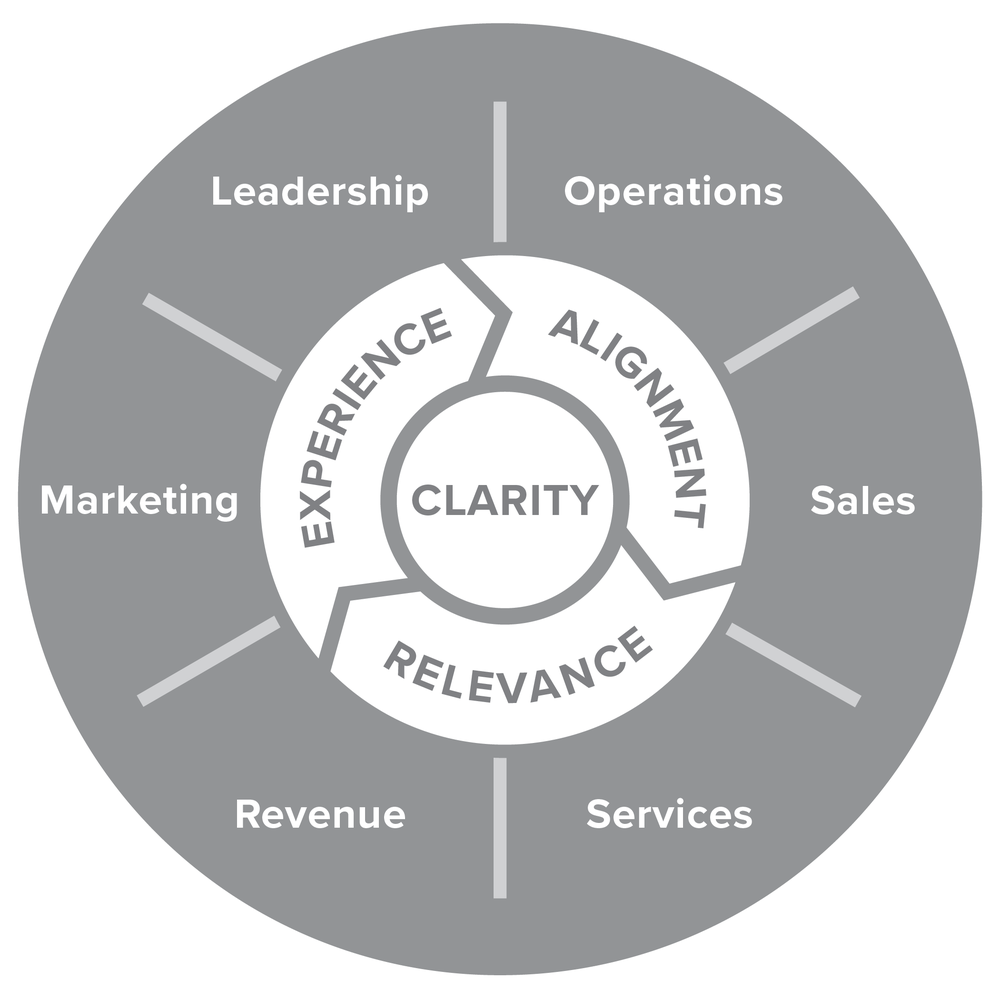
"You're building trust," he says. "You want to be that name that people remember when they have the need, and they've already learned to trust you." The book includes playbooks for CSRs, field professionals, and field training alongside the brand strategy for exactly that reason.
The owner can be the bottleneck
Brian thinks more contractors will do what Gorjanc did and bring a senior marketer in-house. The limiting factor isn't willingness. It's revenue. A seasoned expert commands a real salary, and most companies can't carry one until they've crossed a certain size.
He sees the industry in tiers: under $1M, around $3M, around $5M, then $10M to $20M and beyond. What stalls a company at each step is usually the same thing. "After working with over 200 companies over 30 years, the owner and leadership are often the bottleneck to growth."
He met a heating and plumbing owner in Utah who illustrated it. "He was at $5 million and still doing his accounting and marketing." The fix is unglamorous. "They've got to build a team around them to get them to that $10 to $20 million and up level."
For the smaller shops, DIY marketing isn't going away, and AI will make it more capable. But he's skeptical that tools alone solve it. The hard part was never making the asset. It's integrating a dozen tools, channels, and vendors into something coherent, and that's still a human job.
Whether or not your name is on the paperwork
What Brian is building at Gorjanc is the thing he has spent 30 years telling clients to build: a flywheel most companies abandon too early, and a brand that holds up after the truck pulls away. The difference now is that he's inside it, accountable for the result.
"It's carrying the stewardship and ownership mindset into whatever company you're working in."
Whether or not his name is on the paperwork.
SearchLight Creators profiles the marketers and operators driving growth inside home services companies. Know someone we should talk to? Tell us about it.